The story of a photograph
The story behind the famous photograph of Ryszard Kapuściński from his African assignment — a journalist's investigation into the origin of a legendary picture.
Author: Anna Krogulec
source: http://www.nowyfolder.com/historia-pewnej-fotografii/
Some time ago I traced every one of the twelve descriptions of photographs in Ryszard Kapuściński’s “Shah of Shahs”. Searching for the pictures that matched them, I felt as though I were uncovering things that had been invisible. Now I wanted to go a step further — to uncover the origin and the story of a photograph that had already been found.
It is one of the few widely available photographs from Kapuściński’s expeditions. Yet although I had seen it in many places, I could not find even a short caption saying where and when it had been taken. I wrote to several websites asking where they had got it from, and received no reply at all. Searching on, I decided to ask the Polish Press Agency, where Kapuściński worked for years. The very next day a short answer came back: “I am very sorry, but we do not hold this photograph.” So where does it come from?
It is black and white, but for something several decades old — and it certainly is that — it is of surprisingly good quality. The figures are sharp; you can easily make out the faces of the men, or the boys, standing there. Each of them wears a more or less complete soldier’s outfit and carries a weapon — a rifle hanging slackly towards the ground or gripped tightly in both hands. And the one who appears to be unarmed, crouching on a step, has a bayonet in his belt. Even in the background, right at the edge of the frame, the camera has caught a hand holding a knife. The dark skin of the subjects suggests the photograph was taken in Africa, most likely during some armed conflict. Behind them stands a building with walls of a raw white, with an ornamental entrance to a guard post. So the photograph might come from a military base, or from the front, or from barracks.
In the centre stands Kapuściński. One hand is on his belt, the other holds a cigarette. His expression seems to me self-assured; an enigmatic shadow plays across his face — perhaps it is pleasure, satisfaction? I find myself thinking it might be pride at standing among these lads, at being alive and well, at having won some skirmish. Or perhaps it is only a surface, a pose kept up in order to save face, to be accepted, or even simply to stay alive. In the photograph Kapuściński is still fairly young, though not young enough for it to have been taken before 1968, when he was in Africa. In the years that followed he travelled around the southern republics of the USSR, then became a correspondent in Chile, Brazil and Mexico in turn. He did not return to the continent until 1974, and in 1975 he went to Angola, where the civil war was under way. That must be exactly when this picture was taken. So the caption could read: “Ryszard Kapuściński in Angola, 1975.” And yet that is still not enough.
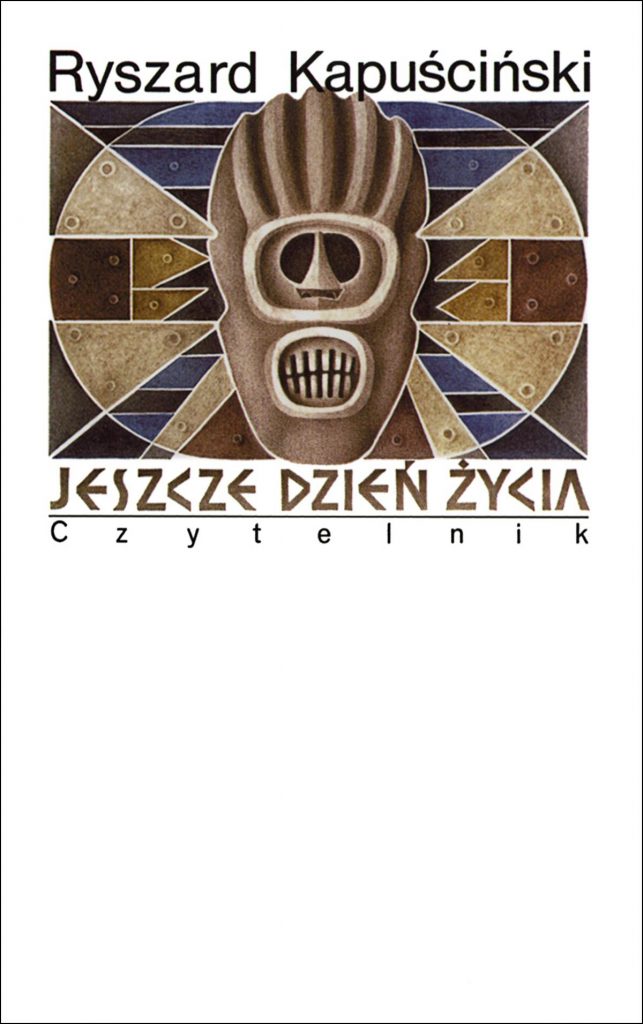
“Another Day of Life” is the title of the book published a year later, the notes from that journey. I borrow the slim Czytelnik edition with an African mask on the cover. The reportage runs to just three chapters: “We are closing the city”, “Scenes from the front”, “Dispatches”. There is also a short section at the end of the book titled “A B C” — something like a present-day Wikipedia entry for “Angola” and “Angolan Civil War”.
I read the reportage from the beginning, but after the first few dozen pages I have to stop. I study the photograph closely and only then read on: One has to learn to live with the checkpoints and to observe their customs, if one wants to travel without hindrance and reach one’s destination alive. The fate of our expedition, and even our lives, are in the hands of the men at the checkpoints; this must be remembered. They are people of various trades and ages. Soldiers from the rear services, home-grown militia, boys seized by a passion for war, and often simply children. The weapons vary: submachine guns, old rifles, machetes, knives and clubs. The dress is arbitrary too, since uniforms are scarce. Sometimes a military tunic, but usually a coloured shirt; sometimes a helmet, but often a lady’s hat; sometimes heavy boots, but as a rule plimsolls or bare feet. It is a poor war, dressed in cheap calico.
If this photograph was taken at the time Kapuściński was writing the rest of “Scenes from the front”, then the people in it are probably the men of Agostinho Neto, then leader of the People’s Movement for the Liberation of Angola (MPLA). Kapuściński stopped among them on the road from Luanda to Benguela. It must have been a long and wearying road across flat desert country, from one oasis to the next.
In Benguela he met commandante Monti, a Portuguese television crew, and a girl named Carlotta, who was assigned to them as an escort on the road to Balombo. When they arrived they learned that the town had been taken by the MPLA that morning. The crew filmed the area and Kapuściński walked with them, taking pictures. Finally, when they got into the car to head back to Benguela, they learned that Carlotta had decided to stay in the town. That evening, as Kapuściński sat in a bar with Monti and the crew waiting for food, he learned there had been a counter-attack on Balombo and that the girl who had escorted them was dead.
If this photograph was taken at the time Kapuściński was writing the rest of “Scenes from the front”, then all of it happened on the same day. And if the events were described in chronological order, day by day, the photograph was taken on 15 October 1975 exactly. If not, it may have been a few days earlier, but it was certainly October, since at the beginning of the month, according to the chapter “We are closing the city”, Kapuściński was still in the capital. So the caption to the picture could read: “Ryszard Kapuściński on the road from Luanda to Benguela. Angola, October 1975.”
A month later, on 11 November 1975, Kapuściński filed a dispatch to PAP: “The war in Angola has changed its character. Until recently it was above all a guerrilla war, an internal one, fought with small arms and light weapons. The intervention of South African forces has changed the situation. Today it is increasingly a war of regular armies and heavy equipment. The young republic is still in a difficult military position, but there is a chance it will manage to defend itself. The Angolan military authorities are gathering forces to go on the offensive.”
The civil war in Angola went on, with breaks, for twenty-seven years, ending in 2002 with the victory of the MPLA — the grouping to which the men in the photograph most probably belonged. Is any of them still alive? Some of them look like teenagers; today they would be sixty or seventy. Perhaps one of them took command, and then found a place in the newly formed government? Who knows, perhaps he even keeps this picture as a memento of the old days. Or perhaps they all simply died in the fighting, a month after it was taken?
Somewhere further on in “Dispatches” I read this: Everyone wants to be photographed. Now me. And now me, camarada, me, mmmeeee! They stand stiffly, some of them saluting. To leave a trace, to fix themselves, to remain somehow. I was here, only yesterday I was here, he took my picture, look, this is how I looked. This was my face as a living man. I stand before you at attention; look at me for a moment before you turn to something else.
About the author: Anna Krogulec
She published her first piece of reportage in the magazine Podróże before she had even begun her journalism studies. That was how her love of backpacking, of literary non-fiction and of writing began. She pursues these three passions at Nowy Folder, which she joined entirely by chance in 2017.
More of Anna Krogulec’s writing can be found at
Gdzie kupić najtaniej?
oferty BUY.BOXLinki do księgarń są linkami afiliacyjnymi (BUY.BOX, Amazon). Jeśli kupisz książkę po kliknięciu, kapuscinski.info może otrzymać niewielką prowizję — cena dla Ciebie się nie zmienia. Ceny pobieramy z porównywarki BUY.BOX w momencie wyświetlenia strony; wiążąca jest cena podana w sklepie.
See also
Kapuscinski in his own words
Memorable lines on travel, truth and the Other — the shortest way into his way of thinking.
Read the quotes → Read nextThe Shadow of the Sun
From one war to a whole continent — forty years of African observation in a single volume.
About the book → The authorWho was Ryszard Kapuscinski?
From a small town on the Polish border to reporting on twenty-seven revolutions — the life behind the books.
Read the biography →source: kapuscinski.info