Study guide
Travels with Herodotus – Summary and Analysis (themes, key issues, quotes)
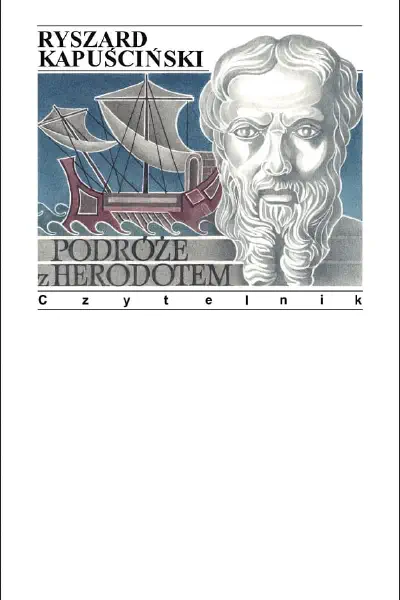
Kapuściński's Travels with Herodotus – summary, key issues, the encounter with the Other, the role of Herodotus, quotes and theses. A study guide to the book.
“Travels with Herodotus” (Podróże z Herodotem, 2004) is Ryszard Kapuściński’s last book — a meditation on travel, on getting to know the world, and on the encounter with the Other. Below you will find a summary, the key issues, themes, the role of Herodotus, and quotes and theses for essays.
Summary in a nutshell
“Travels with Herodotus” is an autobiographical story of a reporter coming of age, interweaving Kapuściński’s recollections of his first foreign trips (India, China, Iran, Africa) with his parallel reading of Herodotus’s “Histories”. The book has no plot in the traditional sense — it is two journeys at once: one across the contemporary world and one into the depths of antiquity, led by the hand of the Greek historian. From their interweaving grows a reflection on knowing the world, on the encounter with the Other, and on the essence of reportage.
Detailed summary
The narrator recalls the beginnings of his career. Before his first trip abroad — to India — an editor hands him a copy of Herodotus’s “Histories”. The book will become his companion for years.
In India the young reporter collides with the barrier of language, the foreignness of the culture, the vastness and the poverty. He learns that getting to know another world requires humility and patience. Then China — another wall: the language, the political impenetrability, the loneliness. Each time, Kapuściński reaches for Herodotus, seeking in his accounts of expeditions parallels to his own experiences.
Over the years come Iran, Africa, the Middle East. The reporter’s recollections interweave with Herodotus’s stories: of the Persian wars, of Croesus, of the customs of peoples that the Greek historian described with undimmed curiosity. Kapuściński reads Herodotus as a mirror — he finds in the ancient text the same mechanisms of power, fear, curiosity and encounter with the stranger that he himself observes in the 20th century.
The book ends with a reflection on Herodotus as the first reporter and on the journey that never truly ends.
Origins and composition
This is Kapuściński’s last book, published in 2004, three years before his death — a summing-up of the reporter’s life experience. The composition is two-track and mosaic-like: contemporary chapters interweave with fragments and paraphrases of the “Histories”. The whole is held together by the figure of Herodotus and a first-person, reflective narration.
Herodotus as a guide
Herodotus (5th century BC), author of the “Histories”, is for Kapuściński a master and forerunner. The Greek historian travelled, observed, talked with people and wrote down their accounts — doing what constitutes the essence of reportage. Kapuściński calls him outright the first reporter and makes him a guide: the “Histories” are a moral and intellectual compass, a model of curiosity about the world and openness to foreign cultures.
Key issues and interpretation
- Travel as knowledge. A journey is not tourism, but the effort of understanding a foreign world; travel changes the one who travels.
- The encounter with the Other. The central problem — how to understand a foreign culture without appropriating it. An attitude of humility before difference.
- Curiosity as a driving force. It is what pushes both Herodotus and the reporter out into the world.
- History as a key to the present. The past (Herodotus) explains the present; human mechanisms recur.
- Self-reflection on the profession. The book is also a treatise on what reportage is and ought to be.
Themes
- Travel and the road – literal and metaphorical; “the journey never ends”.
- The Other / the stranger – the encounter with cultural difference.
- Curiosity and knowledge – the engine of getting to know the world.
- Master and pupil – the Kapuściński–Herodotus relationship.
- Memory and time – the interpenetration of antiquity and the 20th century.
Language and form
“Travels with Herodotus” combines reportage, essay and autobiography. The narration is personal, reflective, at times lyrical. The characteristic device is the interweaving of two time planes (the reporter’s present and Herodotus’s antiquity), which creates a dialogue of epochs. It is a mature, summarising form of literary reportage.
Key quotes
“A journey does not begin the moment we set out, nor does it end when we return home. (…) The film in our memory does not stop running.”
“There is such a thing as the contagion of travel, and it is, in essence, an incurable disease.”
“In a person who believes that everything has already been, the most beautiful thing has died — the beauty of life.”
Essay theses
- Travel is a form of knowledge — it changes a person, not merely provides impressions.
- The encounter with the Other requires humility and openness, not appropriation.
- Curiosity about the world is the driving force of both the historian and the reporter.
- History (Herodotus) explains the present — human mechanisms recur.
- Herodotus as the first reporter — reportage has an ancient lineage.
Frequently asked questions (FAQ)
What is “Travels with Herodotus” about? It is Kapuściński’s last book (2004); it interweaves recollections of reporting trips with the reading of Herodotus’s “Histories” — reportage, essay and a meditation on travel and the encounter with the Other.
Who was Herodotus and what role does he play? An ancient Greek historian, author of the “Histories”; in the book, Kapuściński’s guide and the “first reporter”.
What are the most important themes? Travel as knowledge, the encounter with the Other, curiosity about the world, the art of reportage, history as a key to the present.