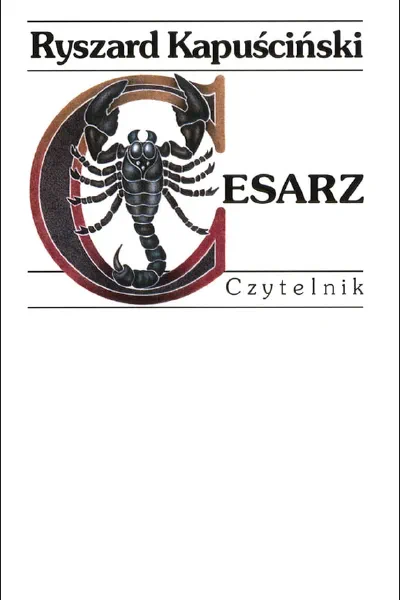
The Emperor
First published: 1978
Ryszard Kapuściński's literary reportage about the court of the Emperor of Ethiopia — an analysis of the mechanisms of despotic power and the final years of Haile Selassie I.
About the Book
The Emperor is a literary reportage published in 1978 — one of Ryszard Kapuściński’s most famous books, and the one that brought him international fame. In it he describes the court of the last Emperor of Ethiopia, Haile Selassie I, and the precise, almost ritual machinery of absolute power.
The book came into being in an unusual way: after the monarchy was overthrown in 1974, Kapuściński returned night after night to the emperor’s former courtiers, dignitaries and servants to record their accounts. From their monologues — delivered in an archaic, servile language — he built a polyphonic portrait of the court, in which every detail, from the man in charge of the cushion to the lapdog allowed to relieve itself on dignitaries’ shoes, served to uphold the ruler’s majesty.
The Emperor is, however, far more than a portrait of a single monarch. It is a universal anatomy of despotism — a study of how a court works, how servility, intrigue and fear are born, and how power decays once it loses touch with reality. In communist Poland the book was also read as a veiled satire on the mechanisms of the regime. It has been translated into dozens of languages and successfully adapted for the stage, among others at London’s Royal Court Theatre.
Historical Background
Haile Selassie I ruled Ethiopia for more than 40 years (1930–1974). His reign ended with a revolution that overthrew the monarchy and established military junta rule.
Significance
The work is not only a portrait of a particular ruler and his court, but also a universal analysis of the mechanisms of despotic power. The book has been translated into many languages and gained international acclaim.
Polish Editions
See the list of Polish editions of The Emperor with ISBN numbers.
Quotes
“The most important thing is the man, His Imperial Majesty, and everything else can be bought and sold.”
Gdzie kupić najtaniej?
oferty BUY.BOXWhere to go next
Three ways to keep going — read a sample, pick the next book, or meet the author.
Kapuscinski in his own words
Memorable lines on travel, truth and the Other — the shortest way into his way of thinking.
Read the quotes → Read nextShah of Shahs
The same mechanism of power in another country — the Shah's court collapses along the same lines as Haile Selassie's.
About the book → The authorWho was Ryszard Kapuscinski?
From a small town on the Polish border to reporting on twenty-seven revolutions — the life behind the books.
Read the biography →source: kapuscinski.info