Study guide
Lapidarium – Analysis and Interpretation (subject matter, themes, quotes)
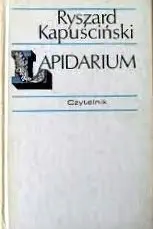
Kapuściński's Lapidarium – analysis: genre, composition, subject matter, themes, quotes and theses. A key to the cycle of the reporter's notes and aphorisms.
“Lapidarium” (1990) is the first volume of Ryszard Kapuściński’s exceptional cycle — a personal notebook of thoughts and aphorisms. Below you will find an analysis: the genre, composition, subject matter, themes, quotes and theses.
In a nutshell
“Lapidarium” is fragment prose — a collection of aphorisms, observations, quotations from reading and reflections, in which the reporter gathers what did not fit into his great books. There is no plot or characters here: there is a mosaic of thoughts about time, human nature, power and the contemporary world, which can be read from any point.
Genre and composition
The title alludes to a collection of stones — each thought is like a separate, polished pebble. The book is deliberately heterogeneous: aphorism, travel note, snatch of conversation, quotation and digression sit side by side. This open, fragmentary form is a conscious choice of genre, close to the diary and the silva (a collection of varied notes).
Origins and place in his work
“Lapidarium” opens a six-volume cycle (1990–2007) that accompanied the author until his death. It is a counterweight to the great reportage: a place for free thought, doubt and commentary on the current world. It is at the same time the writer’s workshop — one can see here how the observations are born that elsewhere become finished reportage.
Key issues and interpretation
- The wisdom of the fragment. The short form condenses the experience of a lifetime of observation.
- The reporter as a thinker. The book shows Kapuściński not only as a witness but as a commentator on his era.
- A diagnosis of the present. Many of the notes concern the media, politics and the acceleration of civilisation.
- Non-linear reading. The form invites returns; meaning reveals itself on the next reading.
Subject matter
- Transience and the passage of time
- Human nature and its constancy
- The mechanisms of power and politics
- The role and traps of the media
- The reporter’s craft and the art of observation
Themes
- Time and transience – the leading theme of the notes.
- Memory – the saving of the fleeting.
- Power – a constant object of the reporter’s reflection.
- The word – its weight and responsibility.
- Observation – looking as the basis of knowledge.
Language and form
The style of “Lapidarium” is concise and aphoristic (hence “lapidary”). Short, polished sentences, often ending in a point. The lack of continuous narration is replaced by the rhythm of successive fragments. It is a form for slow reading and meditation, not a single sequence.
Key quotes
In “Lapidarium” Kapuściński records thoughts about time, human nature and the world — short observations, polished like stones, to which one returns again and again.
See quotes by Ryszard Kapuściński →
Essay theses
- The short, aphoristic form can hold the wisdom of a lifetime of observation.
- “Lapidarium” shows the reporter as a thinker and commentator on his era, not only a witness.
- Fragment prose invites non-linear reading — meaning is born from returns.
- The notebook is the writer’s workshop: one can see in it the birth of later reportage.
Frequently asked questions (FAQ)
What is “Lapidarium”? The first volume of Kapuściński’s notebook — a collection of aphorisms and reflections without a continuous plot.
Where does the title come from? From a collection of stones (Latin lapis); each thought is a polished pebble.
What subjects does it raise? Transience, human nature, power, the media and the reporter’s craft.
How many volumes are there? Six (1990–2007).