Review
"From Near and Far" — Review of "Lapidarium V"
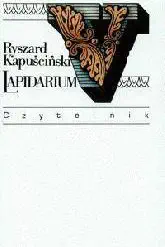
Review of the fifth volume of Ryszard Kapuściński's Lapidarium on the world's inequality, Africa, and the obligation to bear witness in the face of tragedy.
Author: Piotr Śliwiński. Source: Nowe Książki, No. 2/2003. Date of publication: February 2003.
Anyone who has read an earlier volume of Ryszard Kapuściński’s Lapidaria will recognise familiar contents and messages in the newest, already fifth part of the cycle. Poverty and wealth, unequally and unjustly distributed in the contemporary world; Africa, which does not deserve to be condemned in the globalist apportionment of roles to the perpetual playing of hell; processes of unifying patterns of life and thought; acts of revolt against what remains today incomprehensible and alien; terrorism (seen now through the prism of 11 September) and ineradicable evil. Kapuściński says: the world is not perfect and is not approaching perfection — as globalist propaganda of success would have it; nor is it interesting by virtue of its uncontested diversity — as popular postmodern humanist scholarship maintains. He says: the world is tragic, full of problems that we not only cannot solve but cannot even understand. We live in a circle of illusions and appearances, in the wheel of images bearing no relation to reality, though supposedly resembling it, in the din of words incapable of explaining or connecting anything. We are, as it were, stupefied. Whoever, therefore, has seen with his own eyes a hunger that cannot be deceived by anything, to whom it has happened to read the despair written on human faces, who has directly touched ultimate misery, understands what the difference is between knowledge delivered by television and real knowledge. The first sooner or later leads to indifference; the second imposes on a person the obligation to bear witness. It tells the writer to write, to remind, to repeat — until boredom sets in.
Kapuściński has therefore imposed on himself a strict rule aimed at mobilising his own — and the reader’s — awareness of that tragic nature, a tragic nature crowded out by the hedonistic ideals of the age and the daily practice of thoughtlessness as a peculiar virtue. Its value would lie in the absence of radical, subversive tendencies, as well as in the ability to tune one’s moral condition to the conditions for achieving the most desirable of feelings — pleasure. The writer possessing knowledge of the world’s gloomy side therefore necessarily becomes an enemy of literature as a purveyor of harmless delights, siding with the roughness of unwelcome truths or the tedium of nagging reminders. He operates, after all, with information that is fairly widely known, cited in the media; he joins discussions conducted before million-strong audiences; he does not even try, towards the well-read man he addresses, to open passages to any unknown erudite deposits. What does he want, then? I repeat: to shatter the illusion that by knowing — we know, by empathising — we empathise, that we are fulfilling our responsibility towards reality. Kapuściński, not being a determined opponent of postmodernity as a certain form of culture, nor of the Internet, which situates people in an entirely different relation to one another, is to the highest degree troubled by the effects of the ubiquitous m e d i a t e d n e s s of human cognition. Knowledge of evil whose characteristic feature is moral indifference is not knowledge, but only evidence of the decline of ethics.
Kapuściński’s critical rationalism leads him to maintain a distance from intellectual fashions, while protecting him simultaneously against the obscurantist rejection of everything that does not fit within the horizon of an inherited spirituality. Lapidarium stands at the crossroads of two attitudes — openness to new points of view and the preservation of old, classical values. From this dualism comes its significance as a personal chronicle of our times; in it, however, also lies the cause of its ultimate failure.
These notes deny themselves the right to attractiveness. As has been said — attractiveness in thrall to the principle of effortless pleasure is their internal enemy. The point is not to write a book that is banally beautiful and interesting, but one that would stir something in the reader, that would even in some sense help him to take up the habit of reflection. Reflectiveness as habit, reflex, reaction to an episode, independent thinking, distrustful of serially produced commentaries — without that one cannot dream of reaching for higher values such as universal human solidarity. Agreed; only something that does not wish to be successful — usually is not. Something that remains in a state of disagreement with common notions of good literature, without proposing its own definition of it, will in the end succumb to that commonality.
Above all it must find for itself some alternative sanction. How to remain communicative, without respecting, however, the customs of popular culture with its fondness for sentimental banality and bloody sensation, knowing well that this culture has dominated almost everything? In this situation reflections, memories, and remarks — general and particular — can be anchored only in the authority of the writer. But whence does that authority come, by what conferment? The cynical hypothesis, a damaging one, runs as follows: its source is that very criticised culture of irresponsibility towards truth and good, perverse in the highest degree, capable of drawing benefit from the negation of its own forms, able to utilise aversion to itself. The more honest hypothesis: Kapuściński earned his authority through magnificent reportage writing, arising from his travels, from life among the peoples of distant regions, abounding in penetrating sociological and psychological diagnoses, objective and ardent. His looking from afar — which is what we encounter in the Lapidaria — is authenticated by the fact that once he looked from close up. That is the main reason why Kapuściński has the right to this kind of writing, just as Stanisław Lem earned the right to his feuilletons.
Only… But… The trouble is that reflection practised in an aphoristic-notebook style seems in the long run an act of autocannibalism, of eating oneself, of the predatory exploitation of trust and admiration accumulated over decades. All the more so because, at first only occasionally, but as one gets to know successive volumes — more and more frequently, one reaches the conclusion that what the One Who Has Seen says does not differ so greatly from what the One Who Has Seen It On Television has to say.
Piotr Śliwiński
Gdzie kupić najtaniej?
oferty BUY.BOXLinki do księgarń są linkami afiliacyjnymi (BUY.BOX, Amazon). Jeśli kupisz książkę po kliknięciu, kapuscinski.info może otrzymać niewielką prowizję — cena dla Ciebie się nie zmienia. Ceny pobieramy z porównywarki BUY.BOX w momencie wyświetlenia strony; wiążąca jest cena podana w sklepie.