Study guide
Imperium – Summary and Analysis (USSR, themes, key issues, quotes)
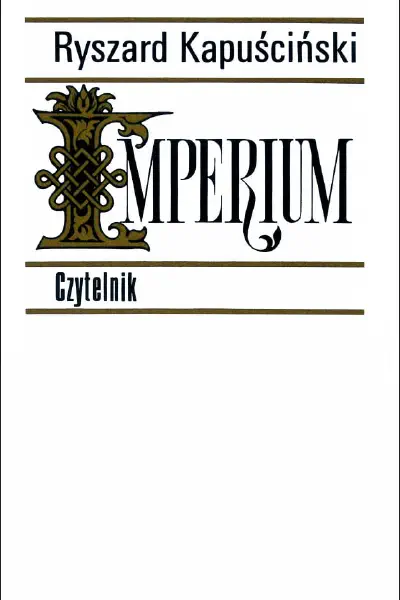
Kapuściński's Imperium – summary, key issues, the image of the USSR, totalitarianism, themes, quotes and theses. A study guide to the reportage about the Soviet Union.
“Imperium” (1993) is Ryszard Kapuściński’s monumental reportage about the Soviet Union — from a childhood encounter with the empire to its collapse in 1991. Below you will find a summary, the key issues, the image of the USSR, themes, and quotes and theses for essays.
Summary in a nutshell
“Imperium” is reportage about the Soviet Union built from Kapuściński’s travels across the vast, multinational state — from Magadan to the Transcaucasus and Central Asia. The book has no plot; it is a three-part journey through time and space that begins with a childhood experience of occupation, leads through decades of life under a totalitarian system, and ends with the collapse of the empire in 1991. From the whole emerges a reflection on the nature of totalitarian power and the price the individual pays for it.
Detailed summary
Part I – “First Encounters (1939–1967)”. The point of departure is Pinsk in 1939 — the author’s hometown, seized by the Red Army. The young Kapuściński experiences occupation, deportation, fear and hunger. It is his first, traumatic encounter with the empire. Later, as a reporter, he takes his first journey on the Trans-Siberian railway, discovering the vastness and might of the USSR.
Part II – “A Bird’s-Eye View (1989–1991)”. Kapuściński traverses the republics: the Transcaucasus (Armenia, Georgia, Azerbaijan with the conflict over Nagorno-Karabakh), Central Asia (Uzbekistan, the catastrophe of the Aral Sea, the legacy of cotton monoculture), Siberia and Kolyma — the land of the Gulag. He observes ethnic tensions, poverty, environmental destruction and the memory of Stalinist terror.
Part III – “The Sequel Continues”. A direct account of the collapse of the USSR: the 1991 coup, the weakening of the centre, the awakening of national aspirations. The empire that seemed eternal falls apart before the reporter’s eyes.
Origins and composition
“Imperium” appeared in 1993, soon after the collapse of the USSR. Its composition is tripartite and personal: it begins with an autobiographical recollection of Pinsk, moves into travel reportage, and ends with a testimony to a historic turning point. The book is held together by a first-person, reflective narration that combines observation with essayistic meditation on totalitarianism.
The image of the USSR
Kapuściński presents the USSR as a colossus of many faces: a multinational empire held together by force and fear, with deep ethnic tensions beneath the surface. He shows the price of totalitarianism — the Gulag, deportations, a ruined environment (the Aral Sea), pervasive shortage and dread. At the same time he notices ordinary people, their dignity and their weariness with the system.
Key issues and interpretation
- An anatomy of totalitarianism. How a totalitarian system penetrates and deforms the life of the individual.
- The empire as a construction. The artificiality of a multinational entity held together by violence — and its inevitable collapse.
- Memory and trauma. Personal experience (Pinsk) as the key to understanding history.
- The individual against the system. Fear, adaptation, survival.
- A testimony to a turning point. Reportage as a record of the fall of one of the phenomena of the 20th century.
Themes
- Totalitarianism and power – the mechanisms of a system of oppression.
- The empire and its collapse – the greatness and fragility of a colossus.
- Memory and trauma – Pinsk, deportations, the Gulag.
- Multinationality – a mosaic of peoples and conflicts.
- Space and immensity – the vastness of geography as an element of experience.
Language and the form of reportage
“Imperium” is literary reportage with elements of the essay and autobiography. The first-person narration combines the concreteness of observation with philosophical reflection on power and history. The multi-layered composition (recollection – travel – testimony) creates a panorama of the empire in time and space.
Key quotes
“Flowers do not give off their scent for themselves, but always for someone.”
“An empire defends itself for a long time, but when it begins to fall, it falls all at once and abruptly.”
Essay theses
- Totalitarianism deforms the life of the individual on every level — from fear to shortage.
- An empire held together by force is fragile by nature and sooner or later collapses.
- Personal experience of history (Pinsk) gives deeper insight than cool analysis.
- Literary reportage can be a testimony to an epoch-making turning point.
Frequently asked questions (FAQ)
What is “Imperium” about? It is reportage about the USSR (1993): the author’s travels from the 1950s to the collapse in 1991, with reflection on totalitarianism and the multinational empire.
How many parts does “Imperium” consist of? Three: childhood and the first encounter (Pinsk), travels across the republics, and the collapse of the empire 1989–1991.
What are the most important themes? Totalitarianism, the collapse of the empire, memory and trauma, multinationality, the Gulag and repression.