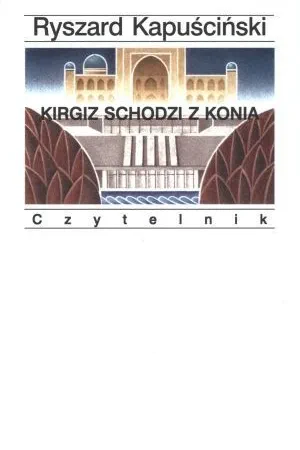
A Kirghiz Dismounts
First published: 1968
Ryszard Kapuściński's reportages from Central Asia and the Caucasus — a record of the collision between tradition and Soviet modernisation in the 1960s.
About the Book
A Kirghiz Dismounts (Kirgiz schodzi z konia) is a collection of reportages by Ryszard Kapuściński, published in 1968, describing the Soviet republics of the Caucasus and Central Asia — Georgia, Armenia and Azerbaijan, as well as Kyrgyzstan, Uzbekistan, Turkmenistan and Tajikistan. It is a portrait of regions stretched between centuries-old tradition and a modernisation imposed from Moscow.
Instead of analysing Kremlin policy from the perspective of the offices of power, Kapuściński looks at the empire “from below” — through the eyes of ordinary people. He describes their daily life, their hospitality and their local problems, as well as the harsh conditions in which they live: from the deserts of Turkmenistan to the high mountains of Tajikistan. The titular “Kirghiz dismounting” becomes a symbol of an entire era — the nomad abandoning a centuries-old way of life to sit behind a desk, stand at a factory machine, or end up on a collective farm.
From this mosaic of images emerges the book’s central idea: beneath the uniform, grey mantle of the USSR lay fascinating, distinct worlds — each with its own national pride, history and temperament — which the Soviet system never managed to fully unify. It is at once a record of a vanishing nomadic exoticism and of the difficult, often painful beginnings of modernity in this part of the world.
Key Themes
- Clash of cultures: The author portrays regions caught between ancient tradition (nomads, clan structures) and imposed Soviet modernisation.
- View from below: Rather than analysing Kremlin policy, Kapuściński focuses on the everyday lives of ordinary people, their hospitality, and local issues.
- Geography and climate: He describes the harsh living conditions — from the deserts of Turkmenistan to the high mountains of Tajikistan — that shape the character of the inhabitants.
Regional Division
- The Caucasus (Georgia, Armenia, Azerbaijan): Focus on national pride, rich history, and the distinctive temperament of the people.
- Central Asia (Kyrgyzstan, Uzbekistan, and others): A picture of sweeping civilisational change — the titular “Kirghiz dismounting” symbolises abandoning the nomadic way of life for factory work or collective farms.
Main Message
The book shows that beneath the uniform surface of the USSR lay fascinating, distinct worlds that could never be fully unified. It is a record of a vanishing exoticism and the difficult beginnings of modernity in the region.
Themes
- Social transformation in Central Asia
- Tradition versus modernity
- The cult of power and political change
- Daily life in a period of transition
Polish Editions
See the list of Polish editions of A Kirghiz Dismounts with ISBN numbers.
Quotes
“A dressed man thinks, a naked man does not. A naked man is capable of any foolishness. Those who created great works were always dressed.”
Gdzie kupić najtaniej?
oferty BUY.BOXWhere to go next
Three ways to keep going — read a sample, pick the next book, or meet the author.
Kapuscinski in his own words
Memorable lines on travel, truth and the Other — the shortest way into his way of thinking.
Read the quotes → Read nextImperium
Return to the same republics as the USSR collapses — Kapuscinski travels them again years later.
About the book → The authorWho was Ryszard Kapuscinski?
From a small town on the Polish border to reporting on twenty-seven revolutions — the life behind the books.
Read the biography →source: kapuscinski.info