Life and work
In the Master's Study
Mariusz Szczygieł's portrait of Ryszard Kapuściński's Warsaw study — thousands of books, notes, cuttings, and the theory of the fragment.
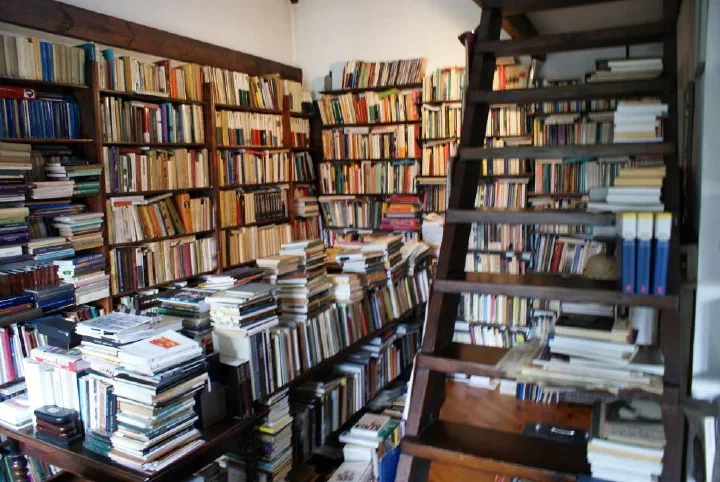
Author: Mariusz Szczygieł, source: Press, published: 15 December 1999
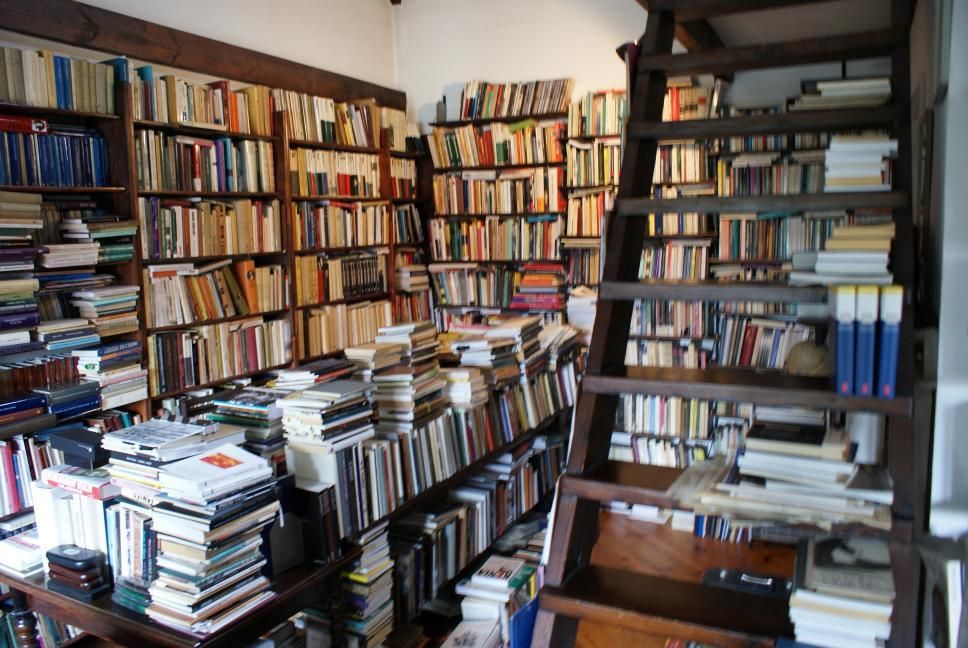
Ryszard Kapuściński’s study
Not a single picture hangs on the walls of his study. But there is not a centimetre of free space either — shelves of books by the thousands stand everywhere. The study is in a pre-war villa in Warsaw’s Ochota district. The Kapuścińskis occupy a flat on the first floor, and have arranged the study in the attic. It is separate from the flat and, deliberately, has no telephone — so as not to distract the author during work.
To the right of the door, a wall of books about Pinsk in Belarus. Beyond them, on the wooden stairs leading to the mezzanine, lie 21 books about the fragment. “This fascinates me,” says Ryszard Kapuściński, “the theory of the fragment, and books written in fragments. The form of notes, notebooks, jottings. In a world so overgrown, so chaotic and hard to order, everything tends toward the collage — a loose collection of fragments.”
Kapuściński’s books move. If they have reached the stairs, that means they will soon be needed.
The inner face of the study door is like a wall newspaper: a collection of paper cuttings pinned with drawing pins. Ryszard Kapuściński speaks of each scrap with the same tenderness as a small boy about his toy soldiers: “Oh, here I have an important quotation from Mozart, in German: ‘I never go to bed without reflecting that, young as I am, perhaps I shall not see another day.’ And here is one from Miłosz, here one from Pascal; this is a souvenir ticket from Disneyland. I went to the United States very late, and to this day I barely know Europe at all — I’ve never even been to Finland or Romania.”
“This is a photograph of an Arab man of middle age,” he continues. “An identity photograph, because they have an interesting custom: when they meet someone new, they give that person their photograph as a gift.” He presses the pin home.
In the middle of the study stands a long wooden trough, which one can walk around. Folders project from the trough — each has its own title. Inside the folders: cuttings, notes, offprints. The author himself diligently collects everything that might be useful in future books and that he considers important.
Two folders require explanation. “Life History” — this contains material about the author himself, including, among other things, articles about foreign editions of Kapuściński’s books (88 translations). “Villa Waldberta” — this holds information about the writers’ retreat near Munich, to which Kapuściński has long been invited but never found the time to visit.
Two wooden beams supporting the ceiling are also important in the study.
The first, a diagonal beam, passes above the chair at the desk. On it hangs a photograph in glass: Kapuściński at dinner with Salman Rushdie and eight others. Where they ate cannot be revealed. Beside it, framed, is a postcard from Edward Stachura, from Mexico, dated 14 January 1975: “Best wishes for the New Year and for the next several dozen, if they don’t blow up our planet.” Further to the right, a framed pre-war photograph of Pinsk. At the end of the beam — a postcard reproduction of the Royal Court Theatre in London, where The Emperor was staged. The diagonal beam is the beam of occasions.
The second beam, vertical, supporting the ceiling, is the strategic beam. Alongside the memorabilia (a map of Cameroon “with the worst road in the world”; a newspaper photograph of Joseph Brodsky, “so it doesn’t get lost”) it holds all the cuttings that may soon be used — for instance in Lapidarium IV. At the bottom of the beam is pinned a text by Mirosław Pęczak from Polityka, with one sentence underlined by Kapuściński: “Entertainment is taking the place of art.”
The largest of the cuttings on the beam is an essay by painter Jacek Sempoliński, with a passage highlighted in pink: “…to produce an immeasurable mass of images for an immeasurable mass of money…”
Why had he underlined precisely that sentence?
“Because the phenomenon of abundance interests me. The world is flooded with everything — even with works of art. Abundance has crushed us,” he replies.