From Pinsk to the End of the World
A biography of Ryszard Kapuściński tracing his Pinsk childhood — the city, its people, the war years, and his journey toward world reportage.
Author: Bartosz Marzec, source: Rzeczpospolita (PLUS MINUS supplement), No. 297, published: 18 December 2004
“Visit the Polesie jungle by boat with a Poleshuk as your guide” — the 1936 Pinsk Tourist Guide tempted visitors. For Ryszard Kapuściński the sight of those slender, long punts — called łodki — was an everyday thing. He saw nothing exotic in the surroundings of his hometown: the marshy, boggy forests and the farms cut off from the world.
“On the other side of the Pina there stretched a plain. When the spring thaw came, everything was flooded,” the writer recalls.
That year two steamers — the Wilno and the Rekord — ran daily from Pinsk to Lubieszów (except Saturdays). To Wójwicze one could travel by the Szybki and the Pelikan. A daytime cab fare was 60 groszy, a night-time one 75. Hotels of the first, second, and third category offered accommodation — among them the English, the Savoy, the Gejbergon, and the Bakelman.
“My Pinsk was a bit like a miniature Łódź, the kind we know from The Promised Land. It was a city of strong contrasts: beside the magnificent Radziwiłł estates stood the homes of a prosperous bourgeoisie — for instance, the Belgian Lurie family, owners of the match and plywood factory. Splendour stood next to enormous poverty.”
Beyond the paved, sewered, gas-lit centre — around the 3rd of May Square and the Kościuszko Avenue leading to it — stood wooden, single-storey or at most two-storey houses with shingle roofs. In autumn and spring mud flooded the streets; planks nailed together along the walls of buildings served as pavements.
“We were mischievous children, and our favourite game was to rock those planks and splash mud onto passers-by. Then we ran for our lives.”
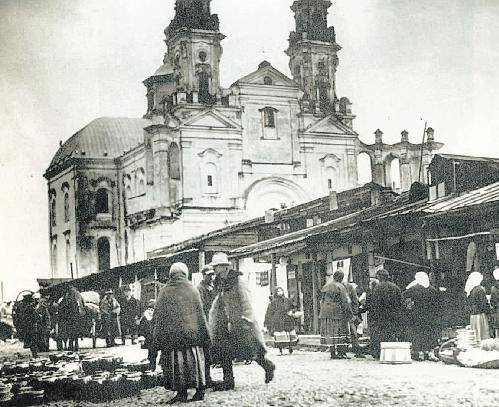
The small boy used to accompany his mother gladly on trips to the market. In photographs from that period, which the writer now keeps in his study, one can see a close row of flat-bottomed boats drawn up on the bank of the Pina. Some have a modest sail; the rest are rowing boats. Moustached peasants in belted shirts and wide trousers sell wood, hay, bilberries, mushrooms, and fish from them.
“They also sold pustoły — bast shoes woven from willow bark. In 1990 I brought some back from my first trip in fifty years to ’the land of my childhood.’ An old man still lived there who knew how to weave them. Yes, without question those were the peripheries of Poland, and it was probably from my love for that place that my later fascination with the peripheries of the world arose. As a reporter I always chose those countries that in some way reminded me of Polesie.”
School
From Lapidarium III: “The memory of one’s own past: a great abyss. Something looms at the bottom. Some particles. Points. Tremors. Here and there. Distorted. Blurred. Illegible.”
Kapuściński: “My mother came from Lesser Poland, from Bochnia; my father from Daleszyce in the Kielce region. My paternal grandfather, Roman Kapuściński, kept the civil register there. In 1919 he entered in the books the birth of Gustaw Herling-Grudziński, born in Skrzelczyce. After the First World War my parents were looking for work. They were told to try their luck in the eastern borderlands, where it was easiest. And so they did: father completed a teachers’ seminary in Prużany; mother ended up in Łuniniec, a town on the border with the Soviets. They only met in eastern Poland, married, and settled in Pinsk, where both were given posts at the primary school. And it was there that I came into the world in 1932. I was baptised in the church of St Charles Borromeo at 55 Albrecht Street. Pinsk at that time had several places of worship: a cathedral on Kościuszko 16, a Jesuit church and monastery on 3rd of May Square, an Orthodox cathedral on Dominican Street, the church of St Barbara on Bernardine Street, and the great synagogue on Queen Bona Street.
Just seven years later, in September 1939, Red Army soldiers would fire artillery at the towers of the Jesuit church, founded by the Radziwiłłs. From Imperium: ‘A drunken artilleryman walked across the empty square shouting: See, we’re shooting at your God! And he says nothing — sits there quietly! Is he afraid, or what? He laughed, then had a fit of hiccups. Our neighbour told my mother that when the dust settled one day, she had seen Saint Andrew Bobola on top of the destroyed tower. The saint, she said, had a very suffering face — they had burned him alive.’”
Just seven years later the Russians would turn the church of St Charles Borromeo into a fuel depot. Just nine years later, three-quarters of the population of the 32,000-strong city would be sent to the ghetto. All would die.
Let us not anticipate events, however. For now, the Holtzmann brothers’ theatre still operates at 13 Krajowski Street, and queues form at the Casino cinema on Butrymowicz Street. Newspapers are published: two Polish ones — Słowo Polesia and Ziemia Wschodnia — and three in Yiddish — Pinsker Wort, Pinsker Sztyme, and Pinsker Łeba.
“I went to Primary School No. 5 on Kościuszko Street 8, where the teaching was naturally conducted in Polish — for education was part of the programme of polonisation of these territories. My classmates were Germans, Ukrainians, Lithuanians, Belarusians, Armenians, and Jews. Diversity of custom and religion was the most ordinary thing in the world in the eastern borderlands. To my hometown, then, I owe my openness to other cultures, my desire to understand and explain them.”
Flames
That year Pinsk had eight fire brigade members, and had it not been for a downpour, the city would probably have burned to the ground.
“I remember from that day the reflections on the walls of the family house; I remember patches of fire. That stayed with me. Pinsk, like every eastern town, was built largely of wood. Every few years it burned completely. In 1936 a heavy rain saved us.”
“I went to Primary School No. 5 at Kościuszko 8, where naturally the teaching was in Polish. My classmates were Germans, Ukrainians, Lithuanians, Belarusians, Armenians, and Jews. The diversity of customs and religions was in the eastern borderlands the most ordinary thing in the world. To my hometown I owe my openness to other cultures, my desire to understand and explain them.”
Colonial Goods and Other Things
The boys who roamed the streets of Pinsk got a thrill from following the dog catchers.
“It was a wretched occupation and they earned pennies. Their nags dragged the carts with wooden cages laboriously. When a catcher spotted a dog, he lassoed it and packed it inside. As the cages filled up, the din rose, and the yelping and barking could be heard throughout the neighbourhood. Such a terrifying spectacle was a great attraction for us,” says Ryszard Kapuściński. “To this day the smell of Pinsk comes back to me. Every house had a little garden, with plum trees, apricots, and apple trees. In autumn the city smelled of the preserves the housewives were making for winter.”
More about smells: the boy was tempted by a small, dark shop selling colonial goods, whose owner sometimes gave him a sweet or a piece of halva. Inside, tin boxes and jars with magical contents were stacked high. In summer an intoxicating scent drifted out onto the street.
From The Shadow of the Sun: “Already on the aircraft steps a new discovery greets us: the smell of the tropics. New? But this is the scent that filled Mr Kanzman’s shop ‘Colonial Goods and Others’ on Peretz Street in Pinsk. Almonds, cloves, dates, cocoa. Vanilla, bay leaves; oranges and bananas sold singly; cardamom and saffron by weight.”
The Summer Was Hot
“The 84th Polesie Riflemen Regiment was garrisoned in the city. From my father’s accounts I know that right after the 1920 war only one battalion had boots. Every Sunday the same story repeated itself: the first battalion marched to church for mass, then came back, took off its boots and handed them to the second battalion, the second passed them on to the third. Before 1939 Poland had three river flotillas: in Gdynia, in Modlin, and in Pinsk. The history of ours is the most tragic and in my view deserves a film. The summer was so hot that all the rivers dried up. The fleet ran aground on shallows — it could neither manoeuvre nor fight. On 17 September the sailors had to abandon their vessels; many were quickly taken prisoner. They died in the mass killing at Mokrany.”
From Imperium: “We said goodbye in summer. He was in uniform, an officer, with tall boots, a new yellow belt and leather gloves. I walked beside him along the street, listening proudly to all the things creaking and rustling on him.”
“In September 1939 my father, a second lieutenant, fought in the Polesie Army; after the Soviet invasion he was taken prisoner. He told me the prisoners were formed into long columns of several hundred people and marched toward Smolensk, walking through forests in fours, escorted by NKVD men. They agreed that all four of them would bolt at the same moment. They had planned it well — there were too few guards to pursue them. They fired, but in the Polesie forest it is hard to hit anything. Father reached the nearest village and exchanged his uniform and those fine officer’s boots for bast shoes and a peasant’s clothes. At night he returned to Pinsk, not knowing that the secret police had already inquired after him several times.”
At that time the deportations to northern Kazakhstan were in full swing.
“The Soviets didn’t care: director or caretaker — if someone was on a state payroll, he was subject to deportation with his whole family. Since my parents were teaching at a primary school, and my father was also an officer, our fate was sealed. My mother learned, however, that under a clause of the Ribbentrop-Molotov Pact a population exchange was being conducted with the Germans. She sold everything of any value, and we got on the train leaving for Lviv. We were travelling to Przemyśl, to my father’s parents. I remember that journey clearly: the engine driver and the fireman would periodically stop the train and announce they were going no further. There was a collection among the passengers — everyone gave whatever they had kept for a black day: rings, silver cigarette cases… Then the bridge, guarded by German and Soviet soldiers, columns of civilians on both sides of the river, and the signal to walk. And that was that.”
Kotik Letaev
Ryszard Kapuściński has for many years been considering a book about his Polesie childhood. “I would like to show the world as seen through the eyes of a small child, preserve its sensibility and language. I would like to do what Andrei Bely achieved in his autobiographical novel Kotik Letaev. Will I manage? Whenever I can find a free moment, I return to Pinsk with pleasure. The journey is not far — you can leave Warsaw in the afternoon and be by the Pina by evening. I wander through those few surviving streets, visit the cemetery — my grandmother is buried there. I always go to Suvorov Street too, formerly Peretz Street, and before that Błotna Street. I look at the house where I spent my earliest years. I look at the gentle hill on which Pinsk lies. Long, long ago, at the time of the spring floods, I could see an endless sea from there, reaching to the horizon. Only later did I learn that the Pina flows into the Yasolda, the Yasolda into the Pripyat, the Pripyat into the Dnieper, and the Dnieper into the Black Sea. If you get into a boat in Pinsk, you can travel to the end of the world.”
Bartosz Marzec
source: kapuscinski.info