A Report from Pińsk
Discover Ryszard Kapuściński's home city through an account of a stay in Pińsk — a reportage tracing the footsteps of the great writer in Belarus.
Author: Robert Nowacki. Date of publication: 2002-01-01
“He was not raised on butter…”
“The ancient history of Pińsk is shrouded in the dense veil of a distant past. Who founded the stronghold of Pińsk and when — no one knows. Whether Herodotus, father of history, giving his description of the mysterious northern land full of forests and swamps, knew anything of this economic junction where the products of the land of rivers and marshes were exchanged for the manufactured goods of Ionian cities; whether a Roman legionary from Dacia and the merchant who followed him reached this land, whence the magnificent pine (pinus) could serve the masters of the world in building victorious triremes, and the stronghold could be adorned with the name ‘Pinscum’ — it is hard to say.”
Guide to the City of Pińsk, 1936
INTRODUCTION
I went to Pińsk in Belarus out of curiosity, out of a desire to see the birthplace of Ryszard Kapuściński. I wanted to confront the stories and texts I had read with reality. It was my first visit to the East, to the former Empire. In his guidebook, Grzegorz Rąkowski — the contemporary “discoverer” of these territories — invites travellers to this region of Europe, urging them to be bewitched by the charm of the Polesie. I was not disappointed — the spell of the Polesie works.
I spent a fortnight of May days in Pińsk. I managed to meet many people — Belarusians, Poles, and Russians — for whom the good of this city is not a foreign concept. I made many wonderful wanderings through the city, searching for traces of pre-war Pińsk, for the traces of Ryszard Kapuściński. My interlocutors naturally knew about the famous writer born in their city; many had read his books, which had arrived here in the 1990s. In the Polish library I found all the most important ones, including the much-loved The Emperor and The Soccer War. Yet it is Imperium that stirs the greatest emotion there — not only because its first chapter is devoted to the pre-war Pińsk.
I am not a reporter, and so will not write a reportage from this trip. But I can do something else. In the text below I have gathered in one place all the facts and information about the years the future Master of Reportage spent in Pińsk. Existing biographies and books about Kapuściński treat this period of his life superficially, in a few sentences. Allow me to bring it closer to lovers of reportage.
“About every road I like to think that it is a road without end, that it runs around the world. And this comes from the fact that from my Pińsk one could reach all the oceans by boat. Setting out from small, wooden Pińsk, one could sail around the whole world.”
POLESIE
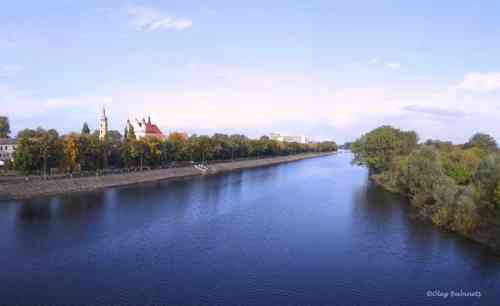
Polesie is the largest swampland area in Europe — 80,000 square kilometres between the Bug and the Dnieper, with the Pripyat River as its artery. Pińsk lies on the left bank of the Pina, a tributary of the Pripyat. Once, the low right bank was flooded for part of the year, as were large sections of the whole of Polesie. The Soviet authorities drained some of the swamps, but fortunately many untouched areas remain.
Pińsk was surrounded by swamps that flooded in spring — and this created a longing to see something different, to see what was happening beyond those swamps, beyond those waters. It was a very small world, but multicultural: a typical borderland town, Galician in character, in which Poles, Jews, Armenians, Ruthenians, Lithuanians, and Belarusians lived together.
Pińsk, the capital of Polesie, is today a city of 130,000 inhabitants — the third largest in the Brest region and the tenth in the country. If you ask a resident who they are, they answer proudly and without hesitation: a Poleshuk! — provided you can still find such a person, born and raised among the swamp country.
Ryszard Kapuściński was born in Pińsk on 4 March 1932. At that time the city had some 35,000 inhabitants, of whom as many as 73% were of Jewish origin. There was no more densely Jewish-inhabited city in the world at the time. Many Germans also lived here, and Poles were only a 10% “minority” — despite the fact that after independence was restored the territory had fallen to Poland.
Pińsk and the years of war gave the future traveller no prospects, no possibility of intellectual development. They gave him the bitter experience of misfortune and humiliation. In the Lapidaria Kapuściński recalls that in winter during the war he had no shoes: they cost 400 złotys, which was 400 too many for his parents’ means. The hungry, tearful ten-year-old boy had to sell 400 bars of soap at one złoty each in order to earn enough for wooden clogs. In those times few could afford the luxury of soap, so the selling dragged on without end. At last the shoes were paid for.
PARENTS
The future writer’s parents had come to Polesie as part of a national campaign to settle these lands and introduce Polish culture. His father, Józef Kapuściński, enrolled in the Teacher Training College in Prużany, and after completing it worked first in Unieniec and then in Pińsk. There he presumably met his future wife, Maria, who had come to Polesie as a young woman from her native Bochnia. In the Catholic cemetery lies his maternal grandmother, Maria Bobek, who died in 1928. Her well-kept grave slab rests in the left part of the cemetery, halfway along. Before the war this Jewish-Catholic cemetery lay outside the city; today it occupies its central section.
BŁOTNA STREET NO. 43
A son was soon born to the young couple, and the following year a daughter. Kapuściński came into the world at Błotna Street No. 43, in a wooden cottage in which his parents rented a modest room on the upper floor. The house stood just beside the main road leading out of the city to the north — what was then Pierwszego Maja Street. The street was later renamed Perec Street, and in 1950 given the name Suvorov Street, which it bears to this day. After the Kapuściński family left Pińsk in 1940, the house was partly inhabited for a while, and in the 1980s fell completely derelict. Half-ruined and vandalised, with cats roaming its rubble — that was how Kapuściński found it when he visited the city in 1997.
“On the former Błotna Street, now Suvorov Street, at No. 43 stands the house in which Ryszard was born and lived with his family for several years. Stands — or stood? It has just been decided to demolish it. The small Polish community wanted to preserve it for symbolic reasons. The central authorities in Minsk wanted to keep it as a historic monument. But the Pińsk city authorities decided, also for symbolic reasons, that the house must disappear: traces of all things Polish must be removed. Kapuściński’s house has fallen into ruin and is now inhabited by cats. It stands in the middle of a busy crossroads, full of cars, buses, and passers-by heading in all directions. A woman passing by turns and calls: ‘What are you staring at?’ ‘I was born here,’ Ryszard answers.”
Only thanks to the efforts of local Poles associated with the Union of Poles in Pińsk was the house ultimately renovated and restored to its former state in 2001. On the front wall was placed only a plaque informing that the building is an architectural monument from the second half of the nineteenth and the beginning of the twentieth century. Unfortunately, no information about who was born there — though hopefully not for long.
Once this house stood among a neighbourhood of similar small, single-storey or first-floor wooden cottages. Now it is like a solitary, defenceless island amid tall, ugly concrete tower blocks that completely drown out and suppress the low-rise architecture of this part of the city.
PÓŁNOCNA STREET
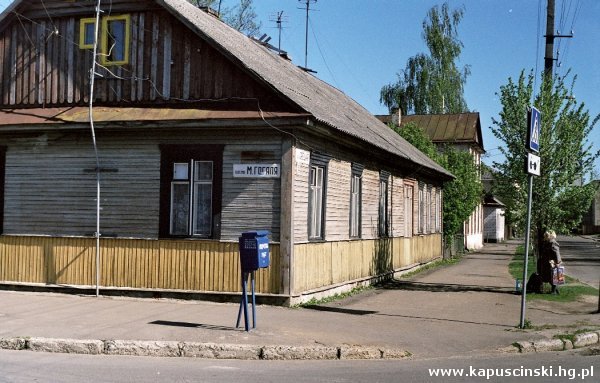
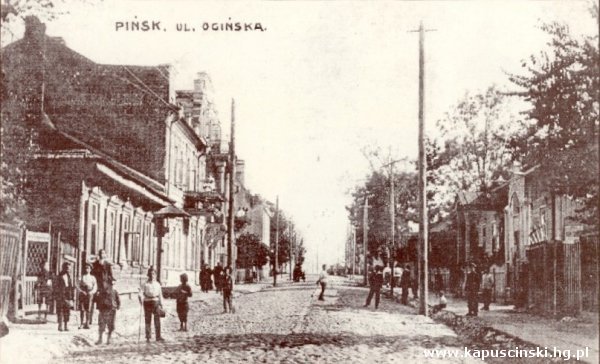
It is not known — and unfortunately the witnesses of those times are no longer living — in what circumstances and when the family moved to their next home, this time on Północna Street, at the corner of Teodorowska Street (now Sovyetskaya 50 / Gogolya). They rented a small room with a dark kitchen from a townswomen, Anna Wierbanowicz-Kindler — one of the few people who still remembered the small boy and his parents. During his stays in Pińsk, Ryszard Kapuściński always visited her, and they undoubtedly recalled together the Pińsk of his childhood years. Unfortunately, Mrs Wierbanowicz died the previous year. I was, however, able to see those rooms from the inside thanks to the kindness of the young Belarusians who live there now. They knew that many years before them a famous Polish writer and journalist had lived there.
WESOŁA STREET 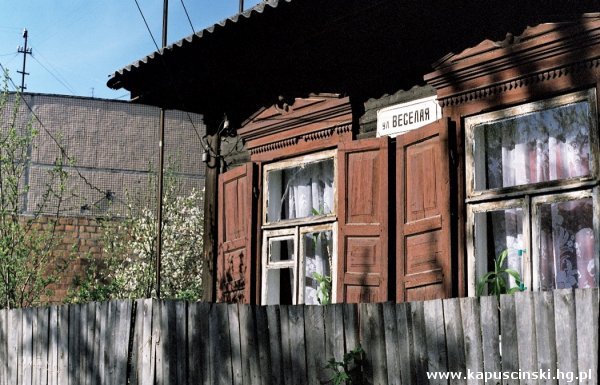
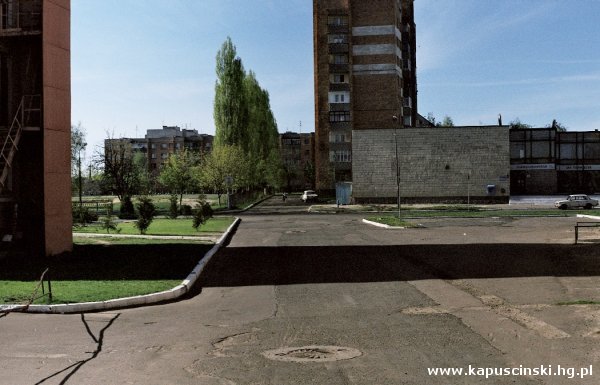
The last few months in Pińsk the family had to spend in yet another place — a modest wooden cottage belonging to the Kwasowski family on Wesoła Street. This was the very periphery of the city, a district inhabited almost exclusively by the Jewish community. It was a small, unpaved, muddy little street lined with single-storey thatched cottages, where they lived in “a small house sunk into the earth.” It was in this house that his mother stood motionless at the window, presumably awaiting the inevitable descent of the NKVD and deportation.
Unfortunately this house did not survive: it was demolished together with several neighbouring ones, and a shop and a tower block were built in their place. However, the initial stretch of the little street fortunately survived, and on it there still stand cottages from the pre-war period.
THE SCHOOL 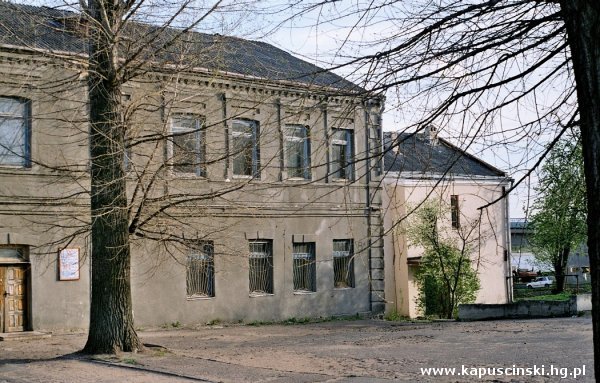
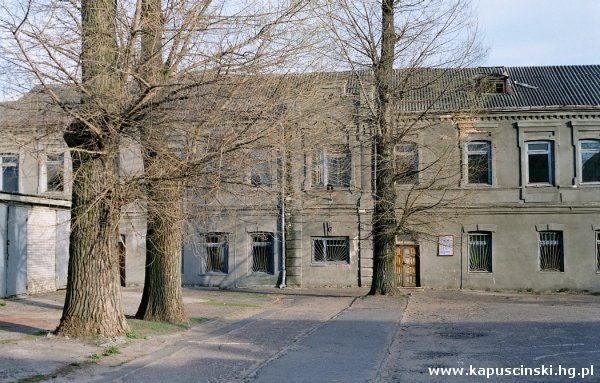
Both parents first worked as rural teachers before moving to a school in the city. It was — I quote from the school certificate — the “Seven-Year Public Primary School No. 5 in Pińsk, at 8 Kościuszko Street.” Today this is Lenin Street and — as before the war — it is the main street of the historic part of the city. His father taught drawing and his mother music. Perhaps because both parents worked there, and because the boy could already read and write, Kapuściński went straight into the second class in September 1938.
In front of the school there was a large square used for assemblies and parades, but also as a gymnastics ground. The trees visible in photographs were of course planted after the war. The school occupied a large, two-storey building of red brick. Only recently has this building been plastered, but it had not yet been painted, so the plaster has gone grey and in places is already peeling away, exposing the faces of the old bricks. From its windows there was a view of the nearby River Pina and of the enormous two-span bridge thrown across it, linking the city with the south.
After the war the school building housed the KGB office; today it is occupied by the state passport office and a police station. But above all, the school was dominated by the enormous Jesuit church together with the monastery building. Its tall towers with bells could be seen from a distance of fifty kilometres, above the boundless swamplands stretching south of the city. This symbol of age-old Polishness greatly irritated the new authorities. After the Red Army seized the city, Polish sailors were murdered, and then a drunken soldier began shooting at the towers of the Jesuit church. From there came the first shots of the Polish defenders of the city. Such an explanation can be found in Imperium:
“In class we reasoned thus: when the Bolsheviks were coming to us, before they saw Poland and before they saw our city, they had first to make out the towers of the Pińsk church. They are so tall. That evidently angered them greatly. Why? We could not answer that. As for the fact of the anger itself, we deduced it from the circumstance that when the Russians had only just entered the city, before they had even caught their breath, before they had looked where each street was, before they had eaten and drawn on their makhorka, they had already quickly set up a cannon in the square, brought up ammunition, and begun shooting at the church.”
Despite not being seriously damaged during the war — with the exception of the bell towers — the Jesuit church was demolished immediately in 1945, leaving only the multi-storey monastery building. Today it houses the museum of the Polesie land.
SUMMER 1939
The family spent their last holiday before the war in the country, at relatives in Rejowiec in the Lublin region. There the outbreak of the war caught them, and from there they had to return on foot through the wilds to Pińsk. This long and arduous journey against the current of the population fleeing into the heart of the country was made still more difficult by a paralysed grandfather on a cart.
“Among the ‘memory exercises’ contained in Nobody Leaves: Impressions of Poland we find the following description:
‘…I walk with my sister beside the cart, it is a simple, barred wagon lined with hay, high on the hay on a linen sheet lies my grandfather. He lies there unable to move, he is paralysed. When a raid begins, the whole crowd that has been patiently marching but is now suddenly seized by panic takes shelter in ditches, burrows into bushes, sinks into potato fields. On the empty, dead road there remains only the cart on which my grandfather lies. Grandfather sees the aircraft flying at him, he sees how they swoop sharply down, how they take aim at the cart abandoned on the road, sees the fire of the on-board weapons, hears the roar of the machines flying over his head. When the aircraft disappear, we return to the cart and mother wipes grandfather’s sweating face…’”
THE ESCAPE
His father, as a reserve officer, was called up in the spring of 1939 and left for the interior of Poland. He fought on the western front, where he fell into Soviet captivity. Driven in a great column of prisoners eastward, towards Katyn and Starobielsk, he escaped with a few comrades during a passage through a forest. Dressed as a Polesian peasant, he returned briefly in autumn to the already Russian-occupied Pińsk to see his wife and children.
Simultaneously with the entry of Soviet forces into Polesie, preparations began for the deportation of “class enemies.” The destination was one: Kazakhstan, and the criterion for deportation also one: a state post in bourgeois Poland. It made no difference whether one was a bank director, a school headmaster, or an ordinary cleaner. Since both of Kapuściński’s parents were teachers and his father was also a soldier in the Polish army, they were inevitably subject to deportation. Perhaps only thanks to the prevailing chaos and lack of systematisation were they able to avoid it. The first transport of Poles and Germans left Pińsk just a few weeks after the city was taken. The wagons standing on the railway siding, filled ever more quickly and efficiently, were an inevitable portent of the approaching danger. In 1940 three transports left Pińsk: on 10 February, 13 April, and the last on 22 April.
Kapuściński’s mother with her two small children left Pińsk in the summer of 1940 on one of the last trains to Lviv, from where she intended to reach nearby Przemyśl. The railway journey resembled the fate of Cezary Baryka in Żeromski’s Spring to Come — here too railwaymen repeatedly stopped the train in the forests to collect payment from the refugees for the onward journey. As the writer himself recalls, people gave away their wedding rings, jewels, and fur coats. Through the bridge crossing at Przemyśl, and then Kraków — the first great city that little Kapuściński had ever seen — the family made their way towards Warsaw. His mother wanted to find his father, whom she fortunately managed to meet on a country road near Izabelin outside Warsaw.
THE BOOK
The last time Ryszard Kapuściński was in his native city was in July 1999, together with a team from Wrocław Television making a film about him. Many people remember that final stay and await with impatience the next visit by the city’s most famous son.
Kapuściński had spoken many times of his intention to write a book about his city, about pre-war Pińsk. For many years Warsaw antiquarian booksellers have been setting aside for him all keepsakes relating to the city. A great many have accumulated — including photographs, books, and postcards from the period — forming what is probably the largest existing archive of its kind on Polesie and the Poleshuki.
Let us hope that the writer will find time to write that book. It is also awaited by many former inhabitants of the swampland scattered throughout the world.
Robert Nowacki
Bibliography: 1. Imperium, Czytelnik, Warsaw 1999. 2. Film “Druga Arka Noego” [The Second Ark of Noah], dir. Piotr Załuski, TVP Wrocław 2000. 3. Czar Polesia [The Spell of Polesie], Grzegorz Rąkowski, Rewasz, Pruszków 2001. 4. “Człowiek w ruchu” [Man in Motion], Krystyna Kwaśniewska, Znak 3/2002. 5. “A visit to Pińsk with Ryszard Kapuściński,” Anders Bodegard, Maria Soderberg, 1999. 6. “Kapuściński w Pińsku” [Kapuściński in Pińsk], Gazeta Wyborcza, 30.10.1997. 7. Gazeta.pl web service. 8. Tygodnik Kultura, 19.11.1978 — interview with RK by Teresa Krzemieńska: “W drodze” [On the Road]. 9. Пинск — волшебная сказка Полесья, Бышэйшая школа, Mińsk 2002 (photographic album of contemporary Pińsk, photos by Oleg Babiniec). 10. Author’s own information.
source: kapuscinski.info